
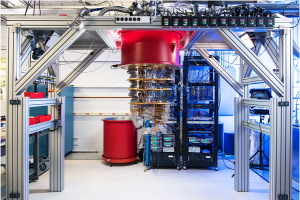
Until today we use systems based on binary, ie 1 or 0, on and off, but in this case we will focus on something that goes beyond the binary world, and is the quantum world, what do we mean by this? Well, quantum computers based on principles of quantum mechanics allow to work outside the binary state, with this can carry multiple processes at once, thus being extremely fast in solving cryptographic problems more efficiently, a quantum system could break ciphers quickly compared to binary (It could take hundreds of years to solve “x” cipher).
Post-quantum cryptography (PQC):
Quantum cryptography is lattice-based, implying the Non-Cloning Theorem that guarantees security in schemes such as Quantum Key Distribution (QKD), since an intruder cannot copy a quantum state and obtain the key without being detected. If he attempted to do so, any measurement attempt would disrupt the state and participants (such as Alice and Bob) would know that an attack had occurred.
Statement of the Theorem:
Given a quantum state ∣ψ⟩|, there does not exist a quantum operation that can copy this unknown state perfectly. In other words, there does not exist a unitary process U such that for any quantum state ∣ψ⟩|, it is satisfied:
U(∣ψ⟩⊗∣0⟩⊗∣0⟩)=∣ψ⟩⊗∣ψ⟩
Where:
⦁ ∣ψ⟩ is the original quantum state.
⦁ ∣0⟩ is an empty initial ground state.
⦁ ∣ψ⟩⊗⊗∣ψ⟩ is the state that would represent the desired copy of the original quantum state.
Its foundation lies in the difficulty of solving certain mathematical problems associated with geometric structures composed of regularly distributed points in a multidimensional space that, although simple in few dimensions, become incredibly complex in high-dimensional spaces, in this context can be imagined as an infinite grid of regularly distributed points in a multidimensional space.
The points in such a structure are the result of adding or subtracting integer multiples of a basis set of vectors. While in two dimensions these operations are relatively straightforward, in higher dimensions, solving these problems becomes computationally difficult.

Quantum Key Distribution (QKD):
Quantum key distribution (QKD) is an innovative approach that uses the quantum properties of light, rather than relying on complex mathematics, to ensure security in the generation and distribution of encryption keys between two parties. This approach forms the basis of quantum security networks, providing a cryptographic solution that is resilient even against attacks by quantum computers.
QKD operation:
Quantum properties of light
QKD is based on principles of quantum physics, such as the Heisenberg uncertainty principle and the non-cloning theorem, which ensure that any attempt to intercept the generated quantum keys alters their state, allowing parties to detect an intrusion.
Random key generation
The encryption keys generated by QKD are completely random, making them virtually impossible to predict. Unlike traditional methods, where keys are generated by mathematical algorithms, QKD uses photons (particles of light) to transmit information about the keys.
Quantum-proof security
One of the main advantages of QKD is that it offers quantum computer-proof security. While quantum computers can threaten cryptography based on traditional algorithms (such as RSA or ECC), QKD remains secure because it does not rely on computational difficulty, but on the laws of quantum physics.
Protocol BB84
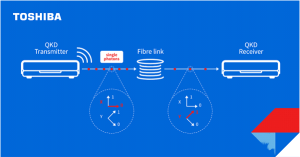
The most commonly used protocol in QKD is BB84, developed by Charles Bennett and Gilles Brassard in 1984. This protocol allows two parties, commonly called Alice and Bob, to exchange cryptographic keys securely over a quantum channel, while using a traditional public channel to verify and correct errors.
Intrusion detection guarantee:
One of the highlights of QKD is its ability to detect any espionage attempts. If an adversary attempts to intercept the photons used to generate the keys, his intervention will alter the quantum properties of the photons, which will alert the parties involved to the presence of an intruder, and the affected keys can be discarded.
You can find a lab that simulates the BB84 at the following link.
Current technologies
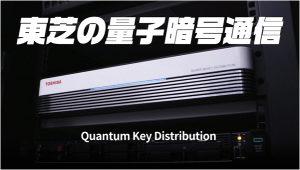
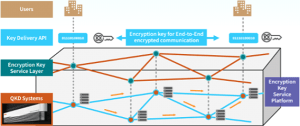
The Japanese company Toshiba has developed hardware systems associated with QKD.
Conclusion
The world of quantum security is complex and wide-ranging. Despite the progress that has been made, there is still much more to explore. Staying ahead of the curve is a must in the cybersecurity arena, where threats and technologies evolve every day, demanding new solutions and innovative approaches to ensure information protection in an increasingly challenging environment.
References:
https://csrc.nist.gov/projects/post-quantum-cryptography
https://www.global.toshiba/ww/products-solutions/security-ict/qkd.html